Hardee’s vs Carl’s Jr.: What’s the Difference & Which Is Better in 2026?
Hardee’s vs Carl’s Jr. — if you’ve ever Googled this, you already suspect something is off. Both chains sport the same smiling red star logo, the same red-and-yellow color scheme, and nearly identical burgers. So is Hardee’s the same as Carl’s Jr.? The direct answer: they are owned by the same parent company — CKE Restaurants — but are not the same restaurant. They were founded separately, operate in different US regions, and since 2018 have been deliberately built into two distinct brands with different menus, different identities, and different target audiences.
This guide covers every real difference and similarity between the two chains — from their separate origin stories and the 1997 merger, to menu differences, regional locations, and which one is actually better depending on what you want to eat.
⚡ QUICK VERDICT — Hardee’s vs Carl’s Jr.
Hardee’s vs Carl’s Jr. Comparison Table
| Category | 🍗 Hardee’s | ⭐ Carl’s Jr. |
|---|---|---|
| Founded | 1960 | 1941 |
| Founder | Wilber Hardee | Carl N. Karcher |
| Parent Company | CKE Restaurants Holdings, Inc. | CKE Restaurants Holdings, Inc. |
| Headquarters | Nashville, TN | Franklin, TN (CKE HQ) |
| Primary Region | Southeast & Midwest USA | West Coast & Southwest USA |
| U.S. Locations | ~1,800+ locations in 32 states | ~700+ domestic locations |
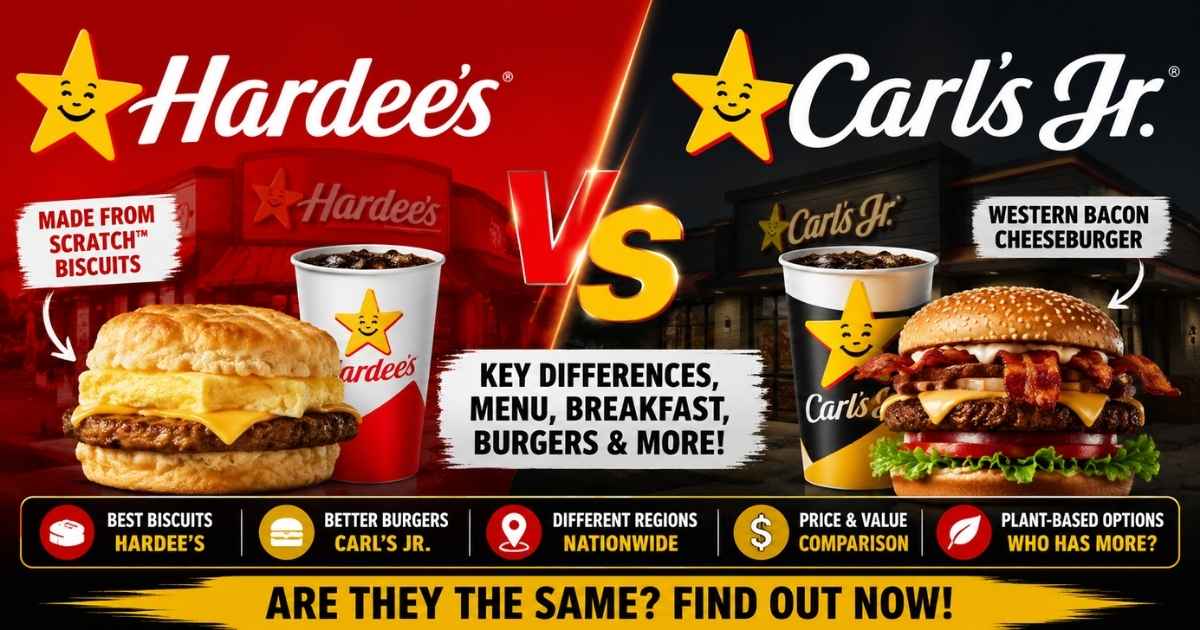
| Signature Item | Made From Scratch™ Biscuit | Western Bacon Cheeseburger |
| Breakfast Quality | ⭐⭐⭐⭐⭐ Breakfast Industry-leading biscuits | ⭐⭐⭐ Standard fast-food breakfast |
| Burger Quality | ⭐⭐⭐⭐ Great charbroiled burgers | ⭐⭐⭐⭐⭐ More premium and gourmet-style burgers |
| Made From Scratch Biscuits | ✅ Yes — baked fresh every 15 minutes | ❌ No |
| Plant-Based Options | ⚠️ Limited | ✅ Broader Beyond Meat lineup |
| Brand Personality | Southern comfort, Americana | Premium, trend-forward, urban |
Are Hardee’s and Carl’s Jr. the Same Company?
Yes and no — and the distinction matters.
Both chains are owned by CKE Restaurants Holdings, Inc. — the same parent company. They share the same corporate leadership, the same logo (the Happy Star), the same overall color scheme, and many of the same menu items. From a corporate ownership standpoint, they are one company.
But they are not the same restaurant in the way that, say, a Subway in California is the same as a Subway in New York. They were founded separately by different people, they have operated as distinct regional brands for over 60 years, they serve some menu items the other does not have, and since 2018 they have been actively building separate brand personalities on purpose.
The clearest way to put it: Hardee’s and Carl’s Jr. are siblings, not twins. Same family. Different personalities.
| Hardee’s | Carl’s Jr. | |
|---|---|---|
| Parent Company | CKE Restaurants Holdings, Inc. ✅ Same | |
| Founded By | Wilber Hardee | Carl N. Karcher |
| Founded In | 1960, Greenville, NC | 1941, Los Angeles, CA |
| Primary Region | Southeast & Midwest USA | West Coast & Southwest USA |
| Logo | Happy Star (shared since early 2000s) ✅ Same | |
| Core Identity | Southern comfort, breakfast | Premium burgers, West Coast |
| Identical Menus? | ❌ No — mostly similar, some unique items each | |
Origin Stories — How Each Chain Started
Carl’s Jr. — Born on the West Coast (1941)
Carl’s Jr. has the older origin story. Carl N. Karcher started with a single hot dog cart in Los Angeles in 1941, counting just $14.75 in sales on his first day. By 1945, he had opened a full drive-in barbeque restaurant in Anaheim, California. When hamburgers became the symbol of American fast food in the mid-1950s, Karcher opened a smaller, burger-focused offshoot — calling it Carl’s Jr. (as in a junior version of his Carl’s Drive-In). The first Carl’s Jr. location opened in 1956.
Carl’s Jr. grew along the Pacific Coast, planting deep roots in California, Nevada, Arizona, and the Southwest — markets characterized by urban density and a more premium, trend-forward food culture.
Hardee’s — Born in the American South (1960)
Wilber Hardee opened his first restaurant in Greenville, North Carolina in 1960 — nearly two decades after Carl Karcher started his hot dog cart on the other side of the country. Hardee built his chain differently: rather than targeting large cities, he focused on small rural towns that other fast-food chains were ignoring entirely.
This strategy worked. Hardee’s expanded rapidly across the Southeast and Midwest through franchising partnerships. By the time the 1990s arrived, Hardee’s had become the fourth-largest fast-food chain in the United States, with more than 3,000 locations concentrated in America’s heartland.
The 1997 Merger — When Two Chains Became One Family
The two chains crossed paths in 1997, when CKE Restaurants — the corporation operating Carl’s Jr. — acquired Hardee’s for $327 million. At that point, CKE operated roughly 700 Carl’s Jr. locations; Hardee’s brought over 3,000 more. Overnight, CKE became one of the largest fast-food operators in the country.
The original idea behind the merger was national domination — one unified burger brand powerful enough to compete with McDonald’s and Burger King coast to coast. For most of the 2000s and 2010s, the two chains were pushed toward being essentially the same restaurant: matching logos, matching advertising campaigns, matching menu items including Thickburgers, hand-breaded chicken tenders, and the Made From Scratch™ biscuits.
But executives eventually realized something important: people on the West Coast and people in the rural Southeast do not want the same things. The forced unity was diluting both brands. So in 2018, CKE made a deliberate decision to pull the two chains apart again — giving each its own distinct identity, separate advertising campaigns, and increasingly different menus that reflected their regional roots.
The 2018 Split: Hardee’s leaned back into its Southern heritage — charbroiled burgers, Made From Scratch™ biscuits, and heartland Americana. Carl’s Jr. leaned into a more premium, West Coast identity — gourmet burgers, plant-based options, and trend-forward marketing. Both chains saw significant jumps in approval ratings after the brands were deliberately separated.
Where Is Each Chain Located?
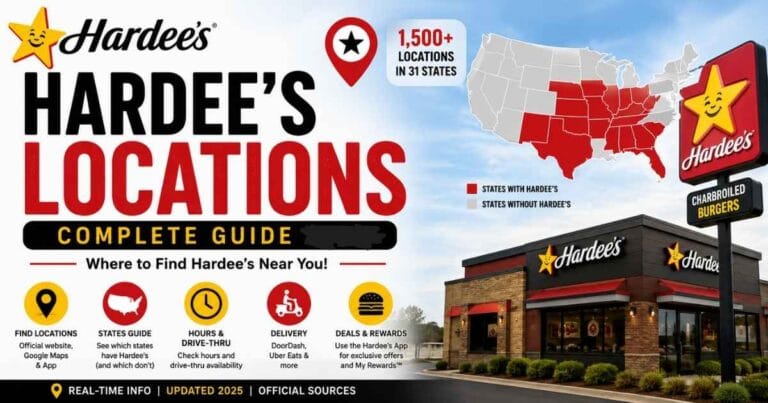
Geography is the clearest practical difference between the two chains for most Americans. The two brands divide the country along a rough diagonal line running from Idaho to eastern Texas.
| Hardee’s | Carl’s Jr. | |
|---|---|---|
| Primary US Region | Southeast & Midwest | West Coast & Southwest |
| US Locations | ~1,800+ in 32 states | ~700+ domestic locations |
| Town Type | Rural & suburban towns | Urban & suburban markets |
| International | Limited | ~700 international locations |
| Strongest States | NC, TN, VA, KY, MO, IN | CA, AZ, NV, TX, UT |
If you live east of the Mississippi, you almost certainly have a Hardee’s nearby and have never seen a Carl’s Jr. If you live in California, you have likely never visited a Hardee’s. Most Americans have only ever experienced one of the two chains — which is why the question “are they the same thing?” comes up so often when people travel.
The Shared Logo — The Happy Star Story
Both chains use the iconic Happy Star — a cheerful, smiling cartoon star in red — as their logo. The color scheme (red, yellow, and black) and the cursive font for the brand name are nearly identical between the two signs. This shared visual identity is the single biggest reason people assume the two chains are the same restaurant.
Here is the important detail most people miss: Carl’s Jr. had the Happy Star first. The star mascot dates back to Carl’s Jr. in the 1960s, long before Hardee’s ever used it. When CKE merged the two chains in 1997 and pushed them toward a unified identity in the early 2000s, Hardee’s adopted Carl’s Jr.’s Happy Star logo. So technically, Hardee’s borrowed the star from its West Coast sibling — not the other way around.
Since the 2018 brand separation, both chains still use the Happy Star logo, but their interior designs, advertising tone, and overall aesthetic have been deliberately differentiated to match their regional identities.
Menu Differences — What’s the Same and What’s Different
This is where things get more interesting. The menus are similar in structure but not identical in content.
What Both Chains Share
- Charbroiled burgers — the signature cooking method for both chains
- Famous Star® burger — available at both (though with slightly different names in some cases)
- Hand-breaded chicken tenders — same recipe at both chains
- Natural-cut fries
- Hand-scooped ice cream shakes
- Breakfast sandwiches
What Only Hardee’s Has
- Made From Scratch™ Biscuits — Hardee’s signature breakfast item, baked fresh in-store every 15 minutes. This is arguably Hardee’s most iconic product and is deeply tied to its Southern identity. Carl’s Jr. does not have this. See our complete Hardee’s biscuit recipe for the full copycat version.
- Frisco Burger — served on sourdough toast, a Hardee’s-specific item
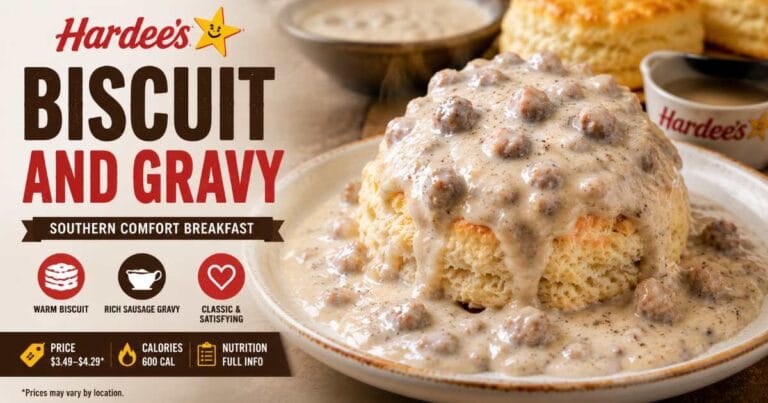
- Biscuit ‘N’ Gravy™ — a Southern-style gravy biscuit not found at Carl’s Jr.
- Pork Chop ‘N’ Gravy Biscuit — another biscuit-focused breakfast item unique to Hardee’s
- Country Ham Biscuit — a regional breakfast staple specific to Hardee’s Southern markets
What Only Carl’s Jr. Has
- Western Bacon Cheeseburger — a West Coast classic with BBQ sauce, onion rings, and bacon
- Plant-based burger options — Carl’s Jr. has been more aggressive with Beyond Meat and plant-based menu items
- California-style items — guacamole burgers, avocado toppings more prominently featured
- Spicy Chicken Sandwich variations — more variety in the chicken lineup at Carl’s Jr.
Menu Comparison at a Glance
| Category | Hardee’s | Carl’s Jr. |
|---|---|---|
| Charbroiled Burgers | ✅ Yes | ✅ Yes |
| Made From Scratch™ Biscuits | ✅ Yes | ❌ No |
| Biscuit ‘N’ Gravy | ✅ Yes | ❌ No |
| Frisco Burger | ✅ Yes | ❌ No |
| Western Bacon Cheeseburger | ❌ No | ✅ Yes |
| Plant-Based Burgers | Limited | ✅ More options |
| Chicken Tenders | ✅ Yes | ✅ Yes |
| Hand-Scooped Shakes | ✅ Yes | ✅ Yes |
| Hash Rounds® | ✅ Yes | ❌ No (uses Hash Browns) |
For the complete Hardee’s menu with current prices and calories, see our full menu guide.
Brand Identity — How the Two Chains Feel Different
Beyond the menu, the two chains have developed genuinely different personalities since the 2018 split.
Hardee’s leans into its Southern and Midwestern roots — the brand evokes Americana, comfort food, and a no-frills, hearty breakfast culture. The marketing tone is traditional and approachable. The Made From Scratch™ biscuit is central to the identity. Hardee’s target audience skews toward families, rural communities, and customers who value consistency and value.
Carl’s Jr. has always had a more aggressive, trend-forward brand personality — the chain that ran provocative advertising campaigns, embraced premium burger culture, and was quicker to adopt plant-based options and limited-time gourmet items. The target audience skews younger and more urban, with a focus on premium quality and innovation.
A useful way to think about it: Hardee’s is the Sunday morning biscuit and gravy chain. Carl’s Jr. is the late-night gourmet burger chain. Same parent. Very different vibes.
Which One Is Better — Hardee’s or Carl’s Jr.?
This depends entirely on what you are looking for.
| If You Want… | Go To… |
|---|---|
| The best fast-food breakfast biscuits in the US | Hardee’s — no contest |
| A classic Southern-style comfort meal | Hardee’s |
| A premium, gourmet-style burger experience | Carl’s Jr. |
| Plant-based burger options | Carl’s Jr. |
| Best overall value for a full breakfast | Hardee’s |
| Western Bacon Cheeseburger | Carl’s Jr. (only option) |
| Biscuit ‘N’ Gravy | Hardee’s (only option) |
Independent food reviewers at publications like Thrillist and QSR Magazine have generally concluded that Carl’s Jr. burgers feel more “gourmet,” while Hardee’s meals deliver greater comfort value and breakfast superiority. Both chains have loyal regional followings — and most Americans only ever experience one of the two chains, which is why neither truly “wins” the comparison for most people.
Frequently Asked Questions
Is Hardee’s the same as Carl’s Jr.?
They are owned by the same parent company — CKE Restaurants — and share the same Happy Star logo, color scheme, and many menu items. However, they are not the same restaurant. They were founded separately in different parts of the country, operate in different regions (Hardee’s in the Southeast and Midwest, Carl’s Jr. on the West Coast), and have distinct menu items and brand identities. Since 2018, the two chains have been deliberately differentiated with separate advertising, menus, and brand personalities.
When did CKE Restaurants buy Hardee’s?
CKE Restaurants acquired Hardee’s in 1997 for $327 million. At the time, CKE operated approximately 700 Carl’s Jr. locations, and Hardee’s added more than 3,000 locations to the portfolio. The merger made CKE one of the largest fast-food operators in the United States overnight.
Who had the Happy Star logo first — Hardee’s or Carl’s Jr.?
Carl’s Jr. had the Happy Star mascot first. The star character dates back to Carl’s Jr. in the 1960s. After CKE merged the two chains in 1997, Hardee’s adopted the Happy Star logo in the early 2000s as part of a push to unify the two brands visually. So Hardee’s borrowed the star from Carl’s Jr. — not the other way around.
Does Carl’s Jr. have biscuits like Hardee’s?
No. The Made From Scratch™ Biscuits are a Hardee’s exclusive and one of its most iconic menu items. Carl’s Jr. does not serve fresh-baked biscuits. This is one of the most significant practical differences between the two chains — Hardee’s breakfast menu is built around the biscuit, while Carl’s Jr. breakfast focuses on a different lineup of breakfast sandwiches and burritos.
Are Hardee’s and Carl’s Jr. menus exactly the same?
No — the menus are similar in structure but not identical. Both chains share items like charbroiled burgers, the Famous Star, chicken tenders, and shakes. But Hardee’s has exclusive items like Made From Scratch™ Biscuits, Biscuit ‘N’ Gravy, the Frisco Burger, and Hash Rounds®. Carl’s Jr. has exclusive items like the Western Bacon Cheeseburger and a broader range of plant-based burger options. Since 2018, the menus have been intentionally diverging further to reflect each chain’s regional identity.
Why does Hardee’s only exist in the South and Midwest?
Hardee’s was founded in Greenville, North Carolina in 1960 and expanded by targeting small rural towns in the Southeast and Midwest that were not being served by other fast-food chains. That geographic focus defined the chain’s footprint for decades. When CKE merged Carl’s Jr. and Hardee’s in 1997, the company kept each brand in its existing region rather than overlapping them, so Hardee’s remained a Southeast and Midwest chain while Carl’s Jr. remained on the West Coast.
Which is bigger — Hardee’s or Carl’s Jr.?
Hardee’s is larger domestically, with approximately 1,800+ locations across 32 US states compared to around 700 domestic Carl’s Jr. locations. However, Carl’s Jr. has a stronger international presence with approximately 700 international locations, giving it a larger global footprint. The combined CKE network across both brands spans roughly 3,800 restaurants in 40 countries.
The Bottom Line
Hardee’s and Carl’s Jr. are not the same restaurant — but they are not completely different ones either. They are two regional chains that grew up on opposite sides of the country, got merged under one corporate roof in 1997, spent 20 years being pushed toward a unified identity, and have since 2018 been pulled back apart to reflect who they actually are.
If you are in the Southeast or Midwest, you have Hardee’s — and its Made From Scratch™ biscuits are worth the visit alone. If you are on the West Coast, you have Carl’s Jr. and its Western Bacon Cheeseburger. Both serve great charbroiled burgers. Both use the same smiling red star. And both are ultimately products of the same great American fast-food story, just told from opposite ends of the country.
Curious about what is actually on the Hardee’s menu with prices? Or want to make Hardee’s famous biscuits at home? Check out our complete Hardee’s copycat biscuit recipe — the one item Carl’s Jr. simply cannot compete with.